

Kiruna, Sweden, may be one of the few places in the world where pad Thai and Swedish meatballs can be enjoyed at the same establishment. At the Arctic Thai and Grill, two unexpected cultures come together in a tradeoff between an incoherent menu and an oddly comforting meal. The town of Kiruna as a whole brings about this same phenomenon. While the many tradeoffs associated with its iron ore mine are uniquely divisive, it proves to be an unforgettable place.
Kiruna, Sweden, is home to one of the world’s largest iron ore mines, owned by Swedish state mining company LKAB (Luossavaara-Kiirunavaara Aktiebolag). Due to extensive mining, the town is literally sinking, making it a unique and urgent example of the challenges and opportunities involved in transitioning to sustainable energy.

This challenge makes Kiruna a particularly compelling case study for the Green Energy Transitions in the North (GET North) project, a two-year initiative from the GW Alliance for a Sustainable Future (ASF) and GW Sustainability Research Institute (SRI). The project brings together researchers from the George Washington University (GW), the University of Alaska Anchorage and Fairbanks and Luleå University of Technology to study green energy transitions in Alaska and northern Sweden and identify ways to maximize the sustainable benefits of these energy systems.
Iron ore mining is crucial for the production of green steel and reducing carbon emissions, but it comes with a cost. Our team of eleven researchers road-tripped from our home base in Luleå to Kiruna to explore this cost and the tradeoffs associated with the mine. The drive should have taken us about five hours, but ended up taking eight. It’s impossible to visit the northernmost town in Sweden without stops for waterfalls, the Arctic Circle entry sign, the Sami Indigenous museum in Jokkmokk, and multiple groups of white reindeer along the way.


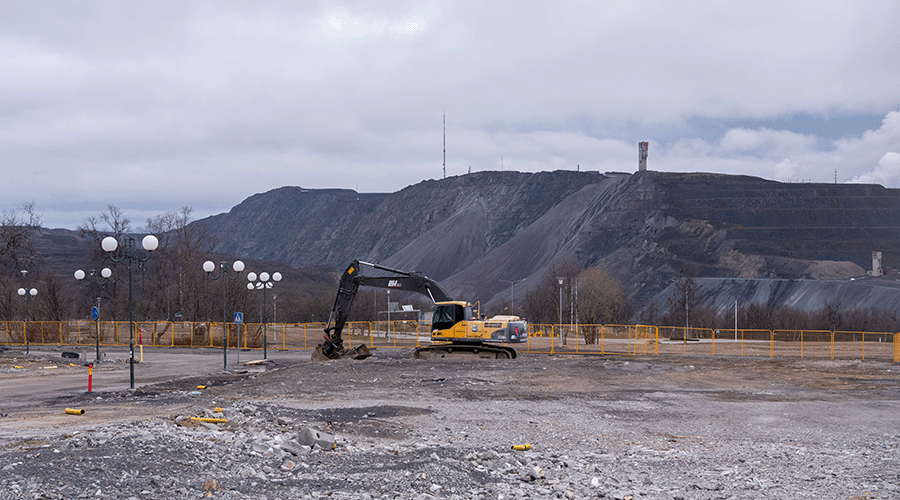
In one of the most radical relocation projects in the world, virtually the entire town of Kiruna is being physically moved two miles east due to the subsidence caused by the mine. As the price of iron has risen and mining operations remove the equivalent of a 12-story building of material from the ground every day, the city has begun to sink. In Kiruna, the implications of this project are already visible—dilapidated buildings sit surrounded by large cranes branded with the LKAB mining company logo, awaiting the inevitable fate of destruction, while only a few treasured edifices will be moved to new locations.


By 2035, Kiruna’s center will be the new downtown district. Kiruna’s “old town” has a historic, quaint feel defined by wooden buildings and nods to the local Indigenous community, and the “new town” with its large glass buildings has a modern, urban feel. Sustainability is a priority of these developments, with features like rainwater management, eco-friendly heating and cooling systems, and greenspaces. Perusing a mall-like building on the bottom floor of an apartment complex in Kiruna’s new town feels like visiting a major urban city. The stark contrast between the old town and the new town is jarring, and the seemingly utopian urban developments feel dystopian instead.

In a town at risk of being swallowed completely, the question is not of the necessity to move the city, but rather the possibility of maintaining community identity in a sustainable city – and whether that possibility exists at all. While the town itself is reliant on the mine, its identity goes much deeper than mining. Situated on Sámi land, many of the buildings in Kiruna hold meaning in Sámi culture, such as Kiruna Church, which was built to resemble a Sámi hut. Elderly Kiruna natives can barely recognize the layout of the town they grew up in, and although some historic buildings will be moved to the new town, some will be lost in the relocation process.

Despite this loss of historic architecture, the new town of Kiruna is marketed as a perfect balance between climate goals and economic goals. At first glance, it seems like a model of an ideal city. It’s more cost-effective than the old town, provides more community spaces, attracts a younger demographic, and grows the tourism industry. With the mine increasingly relying on automation and job opportunities dropping as a result, the economic opportunities created by the new town propose a path for Kiruna to diversify and sustain itself. The relocation project offers a positive outlook from an economic perspective, a green energy perspective, and an urban planning perspective, and it seems to provide a blueprint for the green cities of the future. So, what’s the catch?
In relocating the town of Kiruna, local policymakers and urban planners are surrendering a familiar cityscape for one that lacks the same emotional connections. Over the last fifty years, lakes have been drained, mountains have been built from mine remains, and cracks have emerged in the city center. With each environmental change that the mine creates, the mining company and local government adapt and respond. The relocation of the town is the most drastic response yet, begging the question of what will happen when there is nothing left to extract and what can be done when all the responses have been exhausted.
As the mine continues to expand, the green energy transition will surge forward. LKAB and Kiruna will serve as an example, playing a large role in the green energy transition and a small role in ensuring that land around the world is not lost to climate change. Sámi land will be lost and traditional lifestyles and wilderness will be sacrificed in pursuit of a singular vision of sustainability. Whether framed as promoting green energy or green colonialism, the relocation project in Kiruna is undeniably a glimpse of a new era of unique tradeoffs. The ultimate goal of eliminating the threat of fossil fuels seems to be within reach in this era, but how many lives, histories, and communities will be uprooted in the process?